The Bulbospongiosus Muscle: Keeping Blood In, Clearing the Last Drop
The bulbospongiosus (also called the bulbocavernosus) is the muscle wrapped around the base of the penis, underneath, where the urethra runs. It has three jobs. During an erection it presses on the main vein draining the penis, which slows blood leaving.[1] At orgasm it contracts in rhythm to push semen out. After you urinate it squeezes the last urine out of the urethra.
When it weakens, all three can slip: erections that fade, weaker ejaculation, and drops of urine after you’ve zipped up.
Where it is
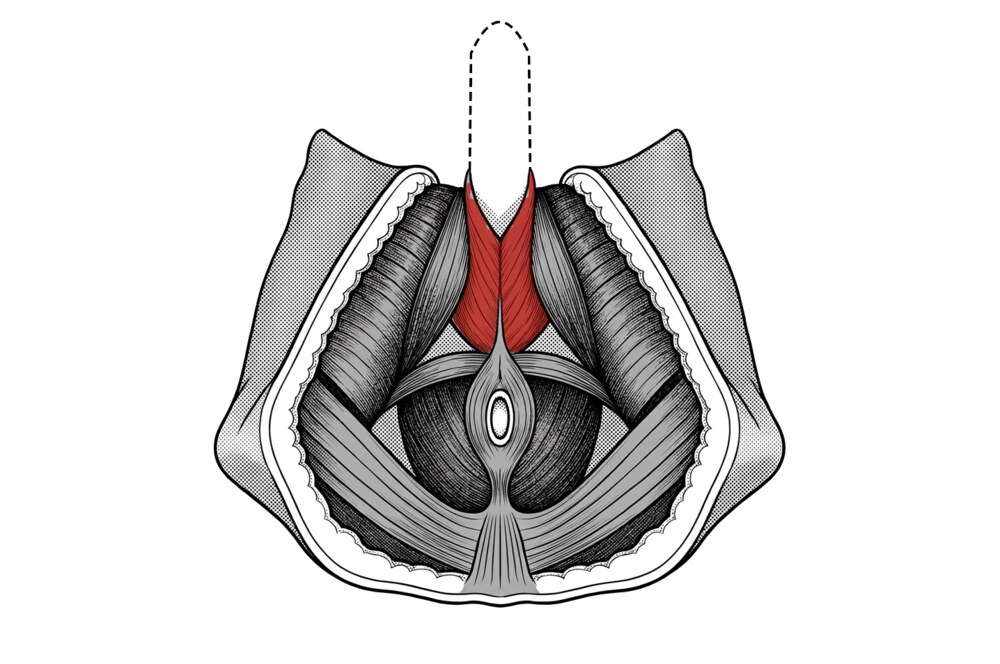
The spongy cylinder that carries the urethra, the corpus spongiosum, ends inside the body in a rounded bulb. It sits in the area between the scrotum and the anus, on the midline. The bulbospongiosus wraps this bulb like a hand around a tube, with fibres reaching forward onto the shaft and over its upper side.
Press gently behind your scrotum and squeeze as if stopping the last of your urine. The firming you feel under your fingers is mostly this muscle.
Job one: keeping blood in
An erection fills through arteries and drains through veins. Some of the main drainage runs through the deep dorsal vein on the upper side of the shaft. The forward fibres of the bulbospongiosus cross over it, so when the muscle contracts it compresses the vein and blood leaves more slowly. Together with the ischiocavernosus, which raises the pressure, it helps an erection get firm and stay firm.
Like its neighbour, it does not start the erection. Needle recordings found both muscles silent during an erection from visual arousal alone.[2] They fire in bursts during sex and whenever you squeeze them on purpose.
That draining side is why training shows up best in men who get hard but lose it. Doctors call this pattern venous leak, and it is where kegels help ED the most. In a randomised trial of 150 men with proven venous leak, five weekly pelvic-floor sessions did as well as vein surgery, and 42% of the trained men were satisfied enough to turn the operation down.[3] A later study using exercise, biofeedback and stimulation got its best results in the same group.[4]
Job two: ejaculation
At orgasm the bulbospongiosus contracts in rhythmic pulses that push semen along the urethra and out.[5] Because it is part of the reflex that makes you finish, training it to contract and relax on purpose is also what pelvic-floor programmes for lasting longer are built on.
Job three: the last drop
After urinating, a little urine stays in the curve of the urethra behind the scrotum. A reflex contraction of the bulbospongiosus normally milks it out. When the muscle weakens, the urine stays there until you stand, walk or sit, and then it leaks into your underwear. That is post-micturition dribble, and it affects about one man in six. The full story is in The Last-Drop Problem.
How to find it and train it
The cues that work best for the muscles at the base of the penis are “shorten the penis” and “lift the scrotum”, which got over 91% of young men to contract the right muscle on ultrasound.[6] For the bulbospongiosus specifically, a second cue helps: squeeze as if pushing out the last drop of urine.
- Relax your stomach, buttocks and thighs.
- Pull the base of the penis in and lift the scrotum, then add the “last drop” squeeze behind the scrotum.
- Hold for a few seconds while breathing, then let go fully.
- Add one strong squeeze right after every time you urinate. Dorey’s programme used this “after-void squeeze” as part of daily training.[1]
Train it with long holds for staying power and quick flicks for the bursts it makes during sex. The trials ran for three months, twice a day, getting harder each week.
Common questions
Bulbospongiosus or bulbocavernosus? Same muscle. Bulbospongiosus is the current anatomical name; bulbocavernosus is older and still common in medical papers.
Can you train it apart from the other pelvic-floor muscles? Not fully. It fires together with the ischiocavernosus and the deeper muscles. The cue changes which part leads.
Will training it fix after-dribble and erections at the same time? It is the same muscle, so training it works on both. The evidence for each is separate; see the linked articles for the numbers.
Where Sahara fits
Sahara’s Full Strength Protocol trains the bulbospongiosus with holds, flicks and the after-void squeeze, getting harder on a set schedule over twelve weeks. It takes 5 minutes a day and tracks every session. How it works with the other two muscles is in The Three Muscles Behind Every Erection.
References
- Dorey G et al. Randomised controlled trial of pelvic floor muscle exercises and manometric biofeedback for erectile dysfunction. Br J Gen Pract 2004;54(508):819–25. PubMed · Full text
- Gerstenberg TC, Levin RJ, Wagner G. Br J Urol 1990;65(4):395–402. PubMed
- Claes H, Baert L. Pelvic floor exercise versus surgery in the treatment of impotence. Br J Urol 1993;71(1):52–7. PubMed
- Van Kampen M et al. Phys Ther 2003;83(6):536–43. PubMed
- Clement P, Giuliano F. Anatomy and physiology of genital organs: men. Handb Clin Neurol 2015;130:19–37. PubMed
- Ben Ami N, Feldman R, Dar G. Int J Environ Res Public Health 2022;19(19):12031. PubMed
Related articles
Educational content, not medical advice. See a clinician for pain, blood in urine, or sudden changes. Results vary; the cited trial reflects its study population. Sources for every figure are available on request. Erection problems can be an early sign of heart or blood-vessel trouble, so see a doctor as well.