Do Kegels Help With ED? What the Trials Show
Yes, for a lot of men. In the best randomised trial, men with erection problems who trained their pelvic floor for three months scored 7 points higher on the standard erection questionnaire than men who only got lifestyle advice. After six months, 41 of the 55 men had improved and 22 were back to normal.[1]
Kegels work best on one particular problem: you get hard, then you can’t stay hard. They do much less when the blood supply itself is the problem. Below is how the muscle helps, what each trial found and where it fell short, and how to tell which group you are probably in.
Why a muscle matters for staying hard
An erection starts with blood vessels. When you’re aroused, the smooth muscle inside the penis relaxes, blood rushes in, and the penis fills. That part has nothing to do with kegels. It depends on healthy arteries, nerves and hormones, which is why heart disease, diabetes and smoking show up so often in men with ED.
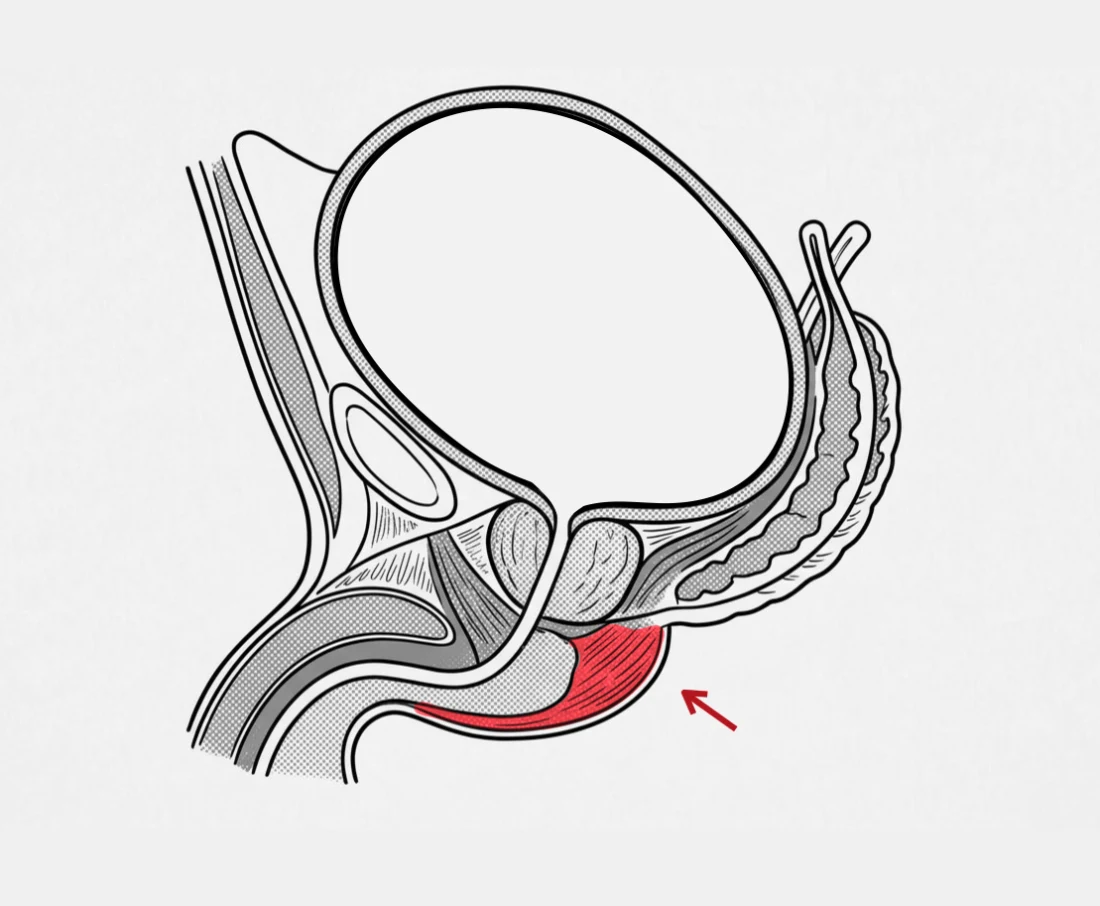
Full is not the same as hard, though. Two pelvic-floor muscles sit at the base of the penis: the ischiocavernosus, which wraps the two roots of the shaft, and the bulbocavernosus (also called the bulbospongiosus), which wraps the bulb underneath. When they squeeze, two things happen:
- The ischiocavernosus pushes the pressure inside the penis above your blood pressure. In nine men measured during an erection, voluntary squeezes raised that pressure by 100 to 525 mmHg.[2] Physiology textbooks put it plainly: the penis gains extra rigidity when the ischiocavernosus contracts.[3]
- The bulbocavernosus presses on the deep dorsal vein, the main vein draining the penis, which slows blood leaving.[1]
These muscles fire in bursts, during thrusting and stimulation or when you squeeze on purpose. They are not clenched the whole time; recordings with needle electrodes found them silent during an erection from visual arousal alone.[4] So the muscle does not create the erection. It is what pushes it from full to firm, and helps it last through sex. A 2014 review by sexual-medicine specialists describes the pelvic floor raising the pressure “above maximum inflow pressure to achieve full penile rigidity”.[5]
That is also why nobody can promise kegels will fix ED. A weak pelvic floor has never been shown to cause ED. Dorey, who ran the main trial, called it a possible cause and tested whether training helps. It did, for most of her men, but not all of them.
What the trials found
| Study | Men | What they did | Result | Limits |
|---|---|---|---|---|
| Dorey 2004, Br J Gen Pract[1] | 55 with ED for 6+ months, aged 22 to 78 | Five weekly sessions with a physiotherapist (exercises, biofeedback, lifestyle advice), then daily home exercises. Control: lifestyle advice only, then crossed over to training at 3 months | At 3 months, randomised: erection score 17.2 vs 8.4, a 7-point difference. At 6 months, all men: 22 back to normal (40%), 19 improved (34.5%), 14 no change (25.5%) | One centre, one physiotherapist. 22 of 55 left early (counted in the totals). The 6-month figure has no untrained group. Desire for sex did not change |
| Claes & Baert 1993, Br J Urol[6] | 150 with ED from proven venous leak | Randomised: vein surgery, or 5 weekly supervised pelvic-floor sessions | Surgery did no better. 42% of trained men were satisfied enough to turn the operation down | Old; the abstract gives no effect sizes; mild venous leak only |
| Van Kampen 2003, Phys Ther[7] | 51 with ED of mixed causes | Exercises, EMG biofeedback and electrical stimulation | 24 back to normal (47%), 12 improved (24%), 6 no change, 9 didn’t finish. Best results in venous leak | No control group; electrical stimulation added |
| Prota 2012, Int J Impot Res[8] | 52 after prostate removal | Randomised: weekly biofeedback for 3 months plus home exercises, or verbal instructions | Potent at 12 months: 47% vs 12.5% | Small; not every man was analysed |
| Ahmad 2026, J Physiother[9] | 90 with type 2 diabetes, all on sildenafil | Randomised: 6 weeks of home pelvic-floor training added, or sildenafil alone (third arm: shockwave) | Training plus the tablet beat the tablet alone on erection score and penile blood flow | Short; shockwave did better still |
Two reviews pull these together. A 2019 systematic review of ten trials found that every ED trial showed improvement, and called the trials small and of low to moderate quality.[10] For balance: a 2024 meta-analysis of exercise trials in men not taking tablets found aerobic exercise clearly helped, while its pelvic-floor subgroup showed no significant effect.[11] After prostate surgery the picture is mixed: of 12 randomised trials, four found a benefit and seven found no clear difference.[12]
The fair reading: the evidence is positive, it comes from a handful of small trials, and the biggest gains show up in men whose problem is staying hard.
Who it is most likely to help
Men who get hard but can’t keep it. If you go soft halfway through, lose it when you change position or put on a condom, or are only ever “about 80%”, blood may be leaving faster than it should. Doctors call this venous leak. It is the group where training matched surgery in Claes’s trial and did best in Van Kampen’s.
Men whose erections are “fine but not as firm”. The squeeze adds rigidity on top of whatever the blood vessels deliver. More rigidity is the thing the muscle can actually change.
Men already on a tablet who want it to work better. Training and tablets act on different parts of the system, and in the diabetes trial the two together beat the tablet alone.
Men after prostate surgery, with the caveat above: some trials help, most show no clear difference, and the surgical team’s rehab plan comes first.
If that sounds like you, Sahara’s two-minute quiz asks how it shows up for you and builds the plan from your answers.
Who it probably won’t help much
If you rarely get hard at all, even in the morning or on your own, the problem is more likely blood flow, nerves or hormones. The muscle can only squeeze what has already filled. Training does no harm here, but on its own it is the wrong first step.
Diabetes, high blood pressure, heart disease, heavy smoking. These damage the arteries and nerves that start an erection. Training can still add something (the diabetes trial above), but expect it to be a partner to medical treatment, not a replacement.
If it started with a new medicine. Some blood-pressure drugs and antidepressants are well known for this. Ask whoever prescribed it before you change anything.
If it’s mostly in your head and only with a partner. Anxiety about performance is real and common, and a muscle won’t fix it. Training sometimes helps indirectly because it gives you a sense of control, but no trial has tested that.
See a doctor as well
ED can be an early sign of heart or blood-vessel trouble. In 300 men with blocked heart arteries, half had ED, and in two thirds of those the ED came first, by about three years on average.[13] About half of men aged 40 to 70 report some degree of erection trouble, so it is common, but it is still worth a blood pressure, cholesterol and blood sugar check.[14] Train the muscle and get checked; one does not replace the other.
Kegels or pills?
Both, if you need both. Tablets like sildenafil and tadalafil work on the blood-vessel side: they help the penis fill. Kegels work on the squeeze that makes it hard and helps keep it. They don’t compete.
Tablets work for many men, but a lot stop. Across 22 studies and 162,936 men, almost half had stopped within a year, most often because of partner problems or because the tablet did not work well enough.[15] Training is slower to start and costs only time, it has no side effects, and once the muscle is stronger it is there without planning ahead.
Never stop a tablet your doctor prescribed because you have started training. Add the training and see what changes.
How to find the muscle and do one squeeze
Most men squeeze the wrong thing at first: belly, buttocks or thighs. The words you use matter. In a study of young men watched on ultrasound, cues like “shorten the penis” and “lift the scrotum” got over 91% to contract the right muscle; “draw in” got 25%.[16]
- Sit or lie down and relax your stomach and buttocks.
- Imagine pulling the base of your penis in towards your body, as if shortening it, and lifting your scrotum. Stopping gas works as a second cue; it uses the same group of muscles.
- If you’re doing it right, the base of the penis twitches in and the scrotum rises. Check once in a mirror if you’re unsure.
- Hold the squeeze for a few seconds while you keep breathing, then let go completely. Feeling the release matters as much as the squeeze.
That is one rep. Don’t practise by stopping your urine flow; it is fine for finding the muscle once, not as a daily habit.
How long before anything changes
In Dorey’s trial the randomised difference was measured at three months, and there was no further significant gain from month three to month six.[1] A few men reported morning erections returning after one to four weeks, but those were individual cases, not a group result. Plan on three months of daily training before judging it.
The harder part is the three months. In the same trial, 22 of 55 men dropped out, and the authors pointed to the commitment of daily exercise as one reason. A single squeeze is easy. Doing the right number of the right kind of squeezes, every day, getting harder each week, for twelve weeks, is where most men stop.
Common questions
Do kegels help erections? In the main randomised trial, yes: 41 of 55 men improved and 22 were back to normal after six months of training. Results are best for men who get hard but lose it.
Can kegels fix ED for good? Nobody can honestly promise that. For some men in the trials the problem went away; for about a quarter nothing changed. It depends on the cause.
How many kegels should I do a day for ED? The trials used a physiotherapist’s progressive plan rather than a fixed number: a few maximal holds in different positions twice a day, plus squeezes during walking and after urinating, built up over weeks. The dose matters less than doing it daily and making it harder over time.
Can kegels make ED worse? No trial reported that. If you have pelvic pain, pain after sex or after training, or the muscle already feels tight, see a pelvic-health physiotherapist; some men need to learn to relax the muscle before strengthening it.
Do kegels make you last longer too? The same muscles carry out ejaculation, and training them helped men gain control in clinical studies. It’s a separate topic with separate evidence.
Are there natural remedies for ED that work? The ones with trial evidence are aerobic exercise, losing weight, stopping smoking and pelvic-floor training. Sexual-enhancement supplements are a gamble: of 776 adulterated supplements flagged by the US regulator over ten years, 353 were sold for sex, and almost half of those hid sildenafil.
Is ED at 30 or 40 normal? It is common at every age, and in younger men it is more worth a doctor’s look: in a ten-year study, men in their 40s with ED went on to heart disease far more often than men without it.
Where Sahara fits
Kegels are not complicated. Finding the muscle takes a minute, and you now know how. What the trials had that a man on his own doesn’t is a plan: the physiotherapist set the dose, raised it every week, and checked he was still doing it. That is the part that gets dropped.
Sahara is that plan in an app. The quiz asks how the problem shows up for you, then the Full Strength Protocol runs twelve weeks of training that gets harder on schedule, sends a notification at the times you pick, has a coach keep you on track, and tracks every session so you can see whether it is working. It takes 5 minutes a day. It doesn’t replace your doctor, and if your problem is blood flow, it won’t fix that on its own. If your problem is staying hard, it is the most direct thing you can train.
Educational content, not medical advice. ED can be a sign of heart or blood-vessel disease; see a doctor, especially if it came on suddenly or you have chest pain, diabetes or high blood pressure. Results vary; the trials describe their own study groups.
References
- Dorey G, Speakman M, Feneley R, Swinkels A, Dunn C, Ewings P. Randomised controlled trial of pelvic floor muscle exercises and manometric biofeedback for erectile dysfunction. Br J Gen Pract 2004;54(508):819–25. PubMed · Full text. Design: Dorey G et al. BJU Int 2005;96(4):595–7, PubMed.
- Lavoisier P, Courtois F, Barres D, Blanchard M. Correlation between intracavernous pressure and contraction of the ischiocavernosus muscle in man. J Urol 1986;136(4):936–9. PubMed
- Clement P, Giuliano F. Anatomy and physiology of genital organs: men. Handb Clin Neurol 2015;130:19–37. PubMed
- Gerstenberg TC, Levin RJ, Wagner G. Br J Urol 1990;65(4):395–402. PubMed
- Meldrum DR, Burnett AL, Dorey G et al. J Sex Med 2014;11(5):1208–20. PubMed
- Claes H, Baert L. Pelvic floor exercise versus surgery in the treatment of impotence. Br J Urol 1993;71(1):52–7. PubMed
- Van Kampen M, De Weerdt W, Claes H, Feys H, De Maeyer M, Van Poppel H. Treatment of erectile dysfunction by perineal exercise, electromyographic biofeedback, and electrical stimulation. Phys Ther 2003;83(6):536–43. PubMed
- Prota C et al. Int J Impot Res 2012;24(5):174–8. PubMed
- Ahmad et al. J Physiother 2026;72(2):122–7. PubMed
- Myers C, Smith M. Pelvic floor muscle training improves erectile dysfunction and premature ejaculation: a systematic review. Physiotherapy 2019;105(2):235–43. PubMed
- Chen Z et al. Andrology 2024;12(8):1632–41. PubMed
- Akdagcik et al. Systematic review. World J Urol 2026;44(1):627. PubMed
- Montorsi F et al. Eur Urol 2003;44(3):360–5. PubMed
- Feldman HA et al. Massachusetts Male Aging Study. J Urol 1994;151(1):54–61. PubMed
- Corona G et al. Andrology 2016;4(6):1002–9. PubMed
- Ben Ami N, Feldman R, Dar G. Verbal instruction for pelvic floor muscle contraction among healthy young males. Int J Environ Res Public Health 2022;19(19):12031. PubMed
Related articles

Educational content, not medical advice. See a clinician for pain, blood in urine, or sudden changes. Results vary; the cited trial reflects its study population. Sources for every figure are available on request. Erection problems can be an early sign of heart or blood-vessel trouble, so see a doctor as well.