The Last-Drop: Why 500 Million Men Dribble After Urinating

Post-micturition dribbling is the clinical term for a minor urine leak that occurs shortly after a man finishes urinating, often after he has zipped up and walked away. While the medical terminology is rarely used outside a clinical setting, the experience is extremely common, and it is not caused by anything the man did.
How common it actually is
Despite affecting roughly a quarter of middle-aged men, the condition receives minimal public attention. A 2019 medical review noted that because the condition is benign—it isn’t painful or dangerous—it largely falls outside of primary research interests. Without pharmaceutical treatments or surgical interventions to market, it is rarely discussed, leaving many men to assume it is simply an unavoidable consequence of aging.
The mechanics behind the leak
The root cause of this specific leak is mechanical. It typically does not involve the bladder or the prostate.
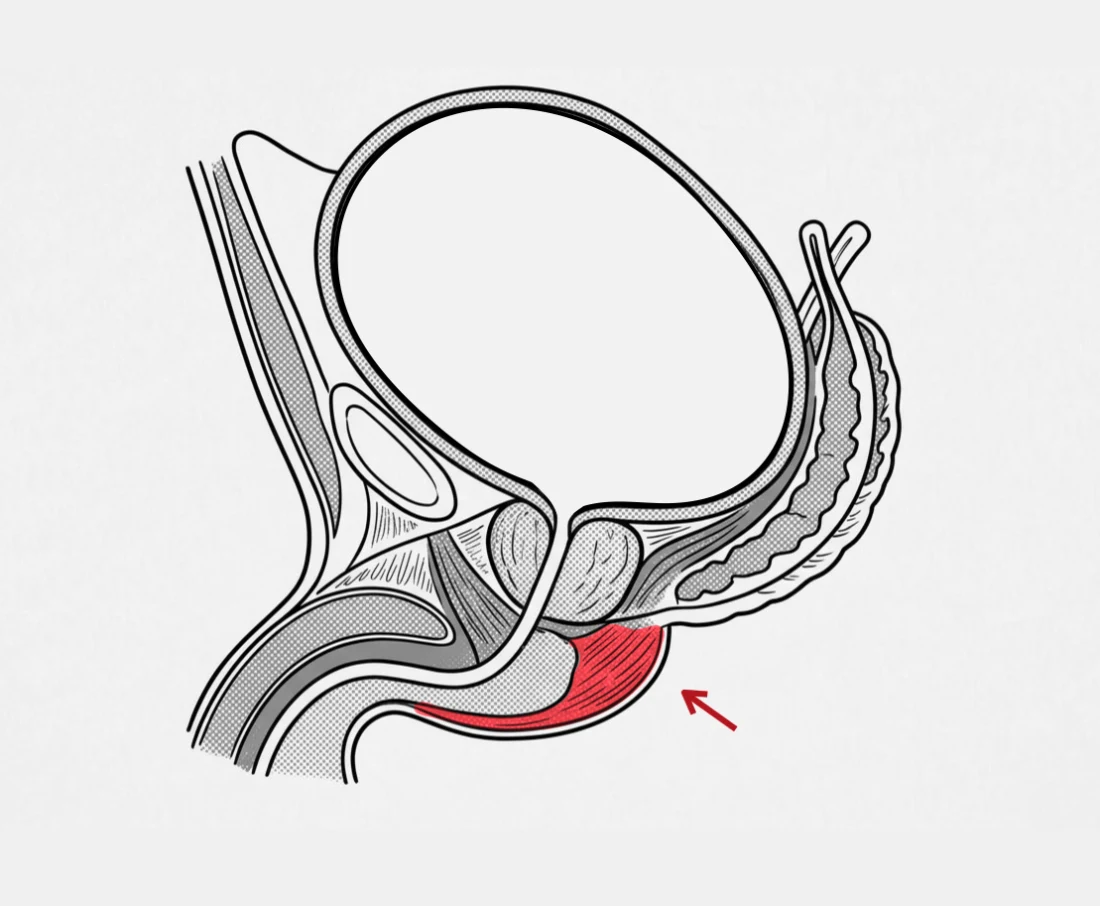
The male urethra features a slight curve where a small volume of urine naturally pools after the bladder empties. Normally, a muscle at the base of the pelvis called the bulbocavernosus contracts to clear this remaining fluid. In medical literature, this action is referred to as “milking” the urethra. Because this reflex is involuntary, most men are entirely unaware the muscle is functioning, and nobody teaches them it is there, so nobody thinks to train it.
With age, the bulbocavernosus muscle can get thinner and weaker. That is not something a man does wrong; it happens to a muscle nobody trains. When the muscle lacks the strength to fully contract, the reflex fails to clear the urethra. The remaining fluid is then displaced by gravity or physical movement a few moments later.
The clinical evidence for training
Because the issue stems from muscle weakness, it responds well to physical conditioning.
In a randomised controlled trial comparing pelvic-floor exercises to standard lifestyle advice for men with post-micturition dribble, the results were highly favorable. After three months of supervised training and three months at home, 75% of the men in the exercise group were symptom-free; the group given lifestyle advice alone was clearly behind at three months. The protocol required a few minutes of daily exercises without any specialized equipment.
Why Kegels on your own usually stop working
Being told to “do Kegels” is not the same as being given the trial’s program. Three things go wrong. Many men squeeze the wrong muscle, because nobody showed them the difference between holding urine in and squeezing the last of it out. The dose never changes, so the exercises stop getting harder while the muscle gets stronger. And there is no number to look at, so when nothing has visibly happened by week three, they stop, which is before the first change usually shows. That is not a willpower problem. Nobody gave them a plan that counts, adjusts and shows progress.
What the assessment does
It asks how long it has been going on, how much comes out, when the drops arrive, and what you have already tried, and it stops and says so if anything in your answers needs a doctor before any training. From the answers it builds the 12-week protocol and then runs it for you: it reminds you when, counts every hold, lengthens the holds on schedule, moves a missed session to the next day, and shows your daily one-tap rating moving from your first day. You give it 5 minutes a day.
Related articles



Educational content, not medical advice. See a clinician for pain, blood in urine, or sudden changes. Results vary; the cited trial reflects its study population. Sources for every figure are available on request.