Kegel Exercises for Men: How to Do Them Right
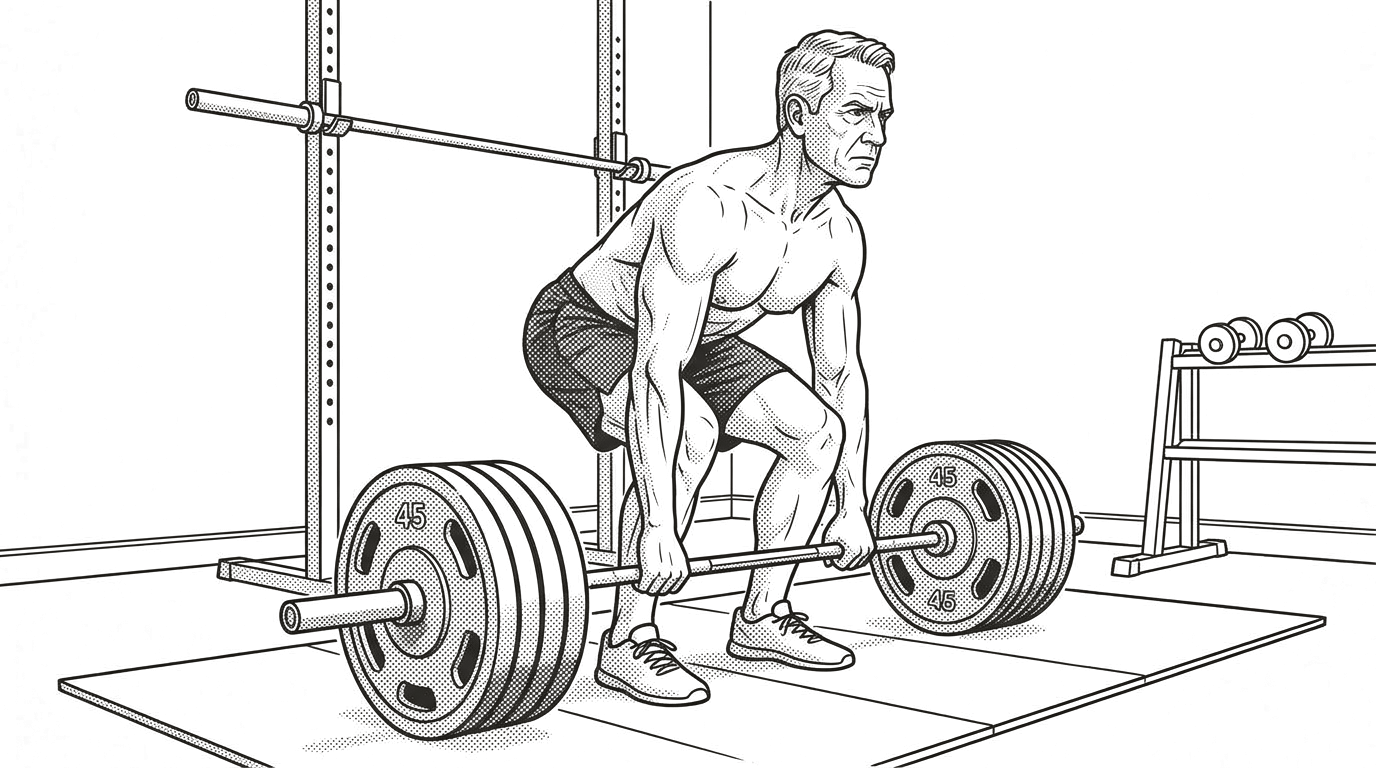
To do a kegel, squeeze the muscle you would use to stop yourself passing wind and to stop your urine mid-flow, so that the base of your penis draws in and your testicles lift slightly, then let it go completely. Your buttocks, thighs and stomach stay loose and you keep breathing the whole time.
That is the whole movement. The hard part for most men is finding the right muscle without help, and then keeping the training going long enough for it to change anything. This page covers the first part in full.
Kegels train your pelvic floor muscle
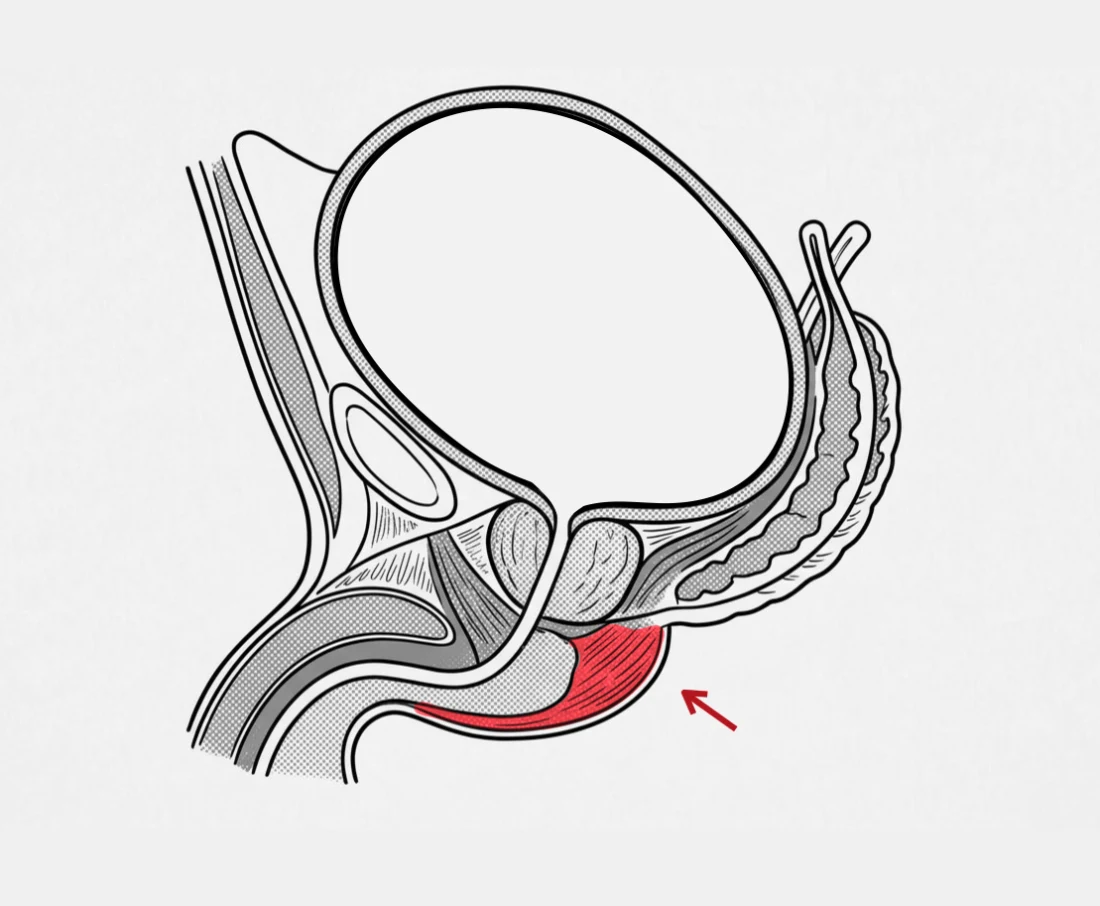
The pelvic floor is a sling of muscle that runs from your pubic bone to your tailbone and sits under your bladder and around the base of your penis. People call it the PC muscle, after the pubococcygeus, one of its parts. Two other parts matter most for men. The bulbocavernosus wraps the base of the penis: it pushes the last urine out of the urethra after you pee and it contracts in rhythm when you ejaculate. The ischiocavernosus sits beside it and adds hardness to an erection when it squeezes (Clement & Giuliano 2015). How the three work together is in The Three Muscles Behind Every Erection.
You use these muscles every day without thinking about them, which is the reason most men have never heard of them. Of 197 men who took our assessment and told us what they thought caused their after-dribble, 21 picked weak pelvic muscles. That is about 1 in 10. The rest named the prostate, the bladder, age, or had no idea.
Like other muscles, the pelvic floor tends to get thinner with age. An MRI study of 163 men found the main pelvic-floor muscle was thinner in older men (Komemushi 2019). Nobody checks it at a routine visit, and in a Dutch study that examined 199 men by hand, only 42 had a pelvic floor working fully normally (Notenboom-Nas 2022).
Find the muscle with three cues
The words you use to find it decide which muscle moves. In a study of 35 men, three cues got more than 9 in 10 of them contracting correctly: “squeeze your anus”, “shorten your penis” and “lift your scrotum”. The cue “draw in your belly” worked for only 1 in 4, and a plain “squeeze your pelvic floor” did little better (Ben Ami 2022).
So use those three cues. Lie on your back with your knees bent, or sit on a firm chair, and try each one:
- Hold in wind. Tighten as if you were in a lift and needed to stop yourself passing gas. You should feel the ring around your back passage close and lift.
- Shorten the penis. Without moving your hips, try to draw the penis in towards your body. Standing in front of a mirror, naked, you will see it pull in slightly.
- Lift the scrotum. You should see your testicles rise a little as you squeeze, and drop as you let go.
When all three happen together, that is the muscle. A useful check: put two fingers on the skin between your scrotum and your anus (the perineum). It should firm up and lift away from your fingers when you squeeze, and soften when you relax. If it bulges down into your fingers, you are pushing instead of lifting.
Most men cannot feel it clearly at first. In the trial that taught 55 men these exercises, a physiotherapist reported that every man got there, “although, initially, this response was often difficult and slow” (Dorey 2004). A faint, slow squeeze on day one is normal.
Do one correct squeeze
There are two kinds of squeeze, and you train both.
The long hold. Squeeze and lift using the cues above, at about the strength you can keep steady. Hold it while breathing normally, counting out loud if that helps. Then let it go fully, and rest for as long as you held it. Hold only for as long as the squeeze stays strong; when it starts to fade, stop and rest. For most men that is a few seconds at first.
The quick squeeze. Squeeze hard and fast, then let go straight away, as if you were flicking the muscle. This is the version your body uses when you cough, lift something, or at the end of urinating.
Two details make each rep count. First, the relax matters as much as the squeeze. If you cannot feel the muscle let go before the next rep, you are not resting it. Second, quality beats number. Five clean squeezes do more than twenty where your buttocks do half the work.
One squeeze to do every day from now on: after you finish urinating, before you zip up, give one firm squeeze. It pushes the last urine out of the urethra and is part of the home routine in the trial where most men with after-dribble became symptom-free (Dorey 2004, BJGP).
If you want to know whether your problem is one these exercises are likely to help, the 2-minute assessment asks about your symptoms and tells you.
The usual mistakes
Most men who say kegels did nothing for them were squeezing a different muscle, holding their breath, or stopped after a fortnight.
| Mistake | What you notice | The fix |
|---|---|---|
| Squeezing the buttocks | Your hips lift off the bed or chair, or your cheeks clench | Put a hand on each buttock. They should stay soft. Use the “shorten the penis” cue |
| Tightening the stomach | Your belly draws in hard or your waistband tightens | Hand on your lower belly. A slight flicker is fine, a hard pull-in is not. The “draw in” cue recruits the wrong muscles (Ben Ami 2022) |
| Squeezing the thighs | Your knees press together | Put a pillow between your knees and keep it loose |
| Holding your breath | You go quiet, your face tightens, you exhale at the end | Count out loud during the hold. You cannot count and hold your breath |
| Bearing down | The perineum bulges into your fingers | You are pushing. Think “lift up and in”, never “push down” |
| Stopping your urine as practice | You do it every time you pee | Use it once to find the muscle, then never again (see below) |
| Not relaxing between reps | The muscle feels tired or tight, never fully off | Rest as long as you held. Feel it let go every time |
| Doing it for two weeks | Nothing changed, so you stopped | Muscles change over months. See the timescales below |
About stopping your urine. Cutting off your stream once is a quick way to feel the muscle. Doing it as your exercise is a bad idea: you are interrupting the bladder while it is emptying, and urologists and physiotherapists advise against it because it can leave urine behind. Find the muscle that way once, then train it away from the toilet.
Kegel benefits for men, with the trial numbers
These are the results from the studies, including the parts that are less impressive than the headlines you will see elsewhere.
Drops after you pee. In a randomised trial, 75% of the men with after-dribble who trained the muscle were symptom-free after three months of supervised training and three months at home. The men given lifestyle advice only were clearly behind at three months (Dorey 2004, Urol Nurs). An earlier trial of 49 men found pelvic-floor exercises reduced the amount of dribble more than pressing behind the scrotum or counselling did (Paterson 1997).
Erections. In the same researchers’ randomised trial in 55 men with erectile dysfunction, men who trained for three months scored 7 points higher on the standard erection questionnaire than men given lifestyle advice only. After six months, 41 of the 55 had improved and 22 were back to normal (Dorey 2004, BJGP). The muscle does not create an erection, which depends on blood flow and healthy blood vessels. It adds the squeeze that makes it harder rather than just full. If you have erection problems, see a doctor as well, because they can be an early sign of heart disease.
Lasting longer. In a clinical study, 33 of 40 men who had always finished within about a minute gained control after a 12-week pelvic-floor programme. On average they went from about 30 seconds to about two and a half minutes (Pastore 2014). Two caveats. That programme was 36 one-hour clinic sessions, not home exercises alone, and it had no comparison group. In the same team’s randomised study, a medicine improved time more than training did (Pastore 2012). The authors put the benefit down to men learning to feel these muscles and to relax them on purpose as they got close, so for this goal the letting go matters as much as the squeeze.
After prostate surgery. In a randomised trial of 208 men still leaking one to 17 years after their prostate was removed, eight weeks of pelvic-floor and bladder training cut leaks from 28 to 13 a week, a 55% drop, against 24% in men who waited (Goode 2011). In the months right after surgery the picture is less clear: a Cochrane review of 25 trials called the value of exercises and other conservative treatment uncertain, partly because most men improve over the first year whatever they do (Johnson 2023). If you are having surgery, ask your surgeon’s team when to start.
Kegels take weeks to show and months to finish
Expect weeks for the first change and about three months for the full result. These are the points at which the studies measured:
| Goal | First measured change | Main result |
|---|---|---|
| After-dribble | 3 months | 75% symptom-free at 6 months (3 supervised, 3 at home) |
| Erections | Some individual men reported night-time erections returning after 1 to 4 weeks | +7 points at 3 months; no further significant gain from month 3 to 6 |
| Lasting longer | Average time up from about 32 to 125 seconds at 6 weeks | 146 seconds at 12 weeks |
| Leaks after prostate surgery | 8 weeks | 55% fewer leaks, held at 12 months |
Sources: Dorey 2004 (both papers), Pastore 2014, Goode 2011, linked above.
Two things follow. A man who stops after two weeks has stopped before any of these studies measured anything. And the muscle needs a reason to keep changing: the men in these trials trained daily, and their programmes got harder as they went.
Men who should not start with kegels
Some men have the opposite problem: a pelvic floor that is too tight and does not relax. Squeezing harder makes that worse. In the Dutch study above, many of the problems the examiners found were muscles that were over-tense or relaxed poorly, not weak ones (Notenboom-Nas 2022).
Stop and see a pelvic-health physiotherapist before you train if you have:
- pain in the pelvis, perineum, testicles, penis or back passage, including pain after sex or after a bowel movement
- burning or pain when you urinate
- a feeling that you cannot empty your bladder or bowel fully
- pain or a cramp when you do a kegel
See a doctor promptly, rather than starting exercises, for blood in your urine, a fever, or symptoms that changed suddenly over a few weeks.
The hard part is keeping going for 12 weeks
Everything above fits on a page, and you can start today. The difficulty comes later. Kegels are invisible, you feel nothing for the first weeks, and there is no moment in the day that reminds you. Of 14 men in our assessment who had tried kegels before and told us how long they kept going, 7 stopped within two weeks. In the erection trial, 22 of 55 men withdrew, and the authors suggested the commitment of daily exercises was part of the reason (Dorey 2004).
That is the part Sahara does. The Full Strength Protocol is 5 minutes a day: the app tells you exactly what to do in each session, makes the sessions harder as you get stronger over 12 weeks, sends notifications at the times you choose, and has a coach who replies when you rate your progress. Nothing to wear, and nobody can tell.
If you want to see whether it fits your situation, take the 2-minute assessment.
Frequently asked questions
Do kegels work for men? Yes, for the right problems. Randomised trials show benefits for drops after urinating, for erections, and for leaks after prostate surgery, and a clinical study shows a benefit for finishing too soon. They work when they are done correctly and kept up for weeks to months.
What muscle do kegels work in men? The pelvic floor, often called the PC muscle. For men the parts that matter most are the bulbocavernosus and ischiocavernosus at the base of the penis.
How do I know if I’m doing kegels right? The base of your penis draws in, your testicles lift slightly, and the skin behind your scrotum lifts away from your fingers. Your buttocks, thighs and belly stay soft and you can keep talking.
How many kegels should a man do a day? Enough to work the muscle without tiring it into poor squeezes, every day. The trials used short daily sessions that grew harder over 12 weeks. Fewer correct squeezes are better than many sloppy ones.
How long does it take for kegels to work for men? Studies measured the first changes at 6 to 12 weeks and the main results at three to six months.
Can you do kegels too much? Yes. Doing too many, or never relaxing between them, can leave the muscle tired or tight. Pain in the pelvis is a sign to stop and see a physiotherapist.
Can kegels make you last longer in bed? In one clinical study, 33 of 40 men gained control after a 12-week clinic programme. The benefit seems to come from learning to feel and relax the muscle, so the letting go is part of the training.
Should I stop my pee to do kegels? Once, to find the muscle. Never as your regular exercise.
Can I do kegels sitting at my desk or driving? Yes, once you can do them correctly lying down. Nobody can see them.
This article is general information and does not replace advice from your doctor.
Related articles


Educational content, not medical advice. See a clinician for pain, blood in urine, or sudden changes. Results vary; the cited trial reflects its study population. Sources for every figure are available on request. Erection problems can be an early sign of heart or blood-vessel trouble, so see a doctor as well.