The PC Muscle in Men: What It Is and What It Really Does
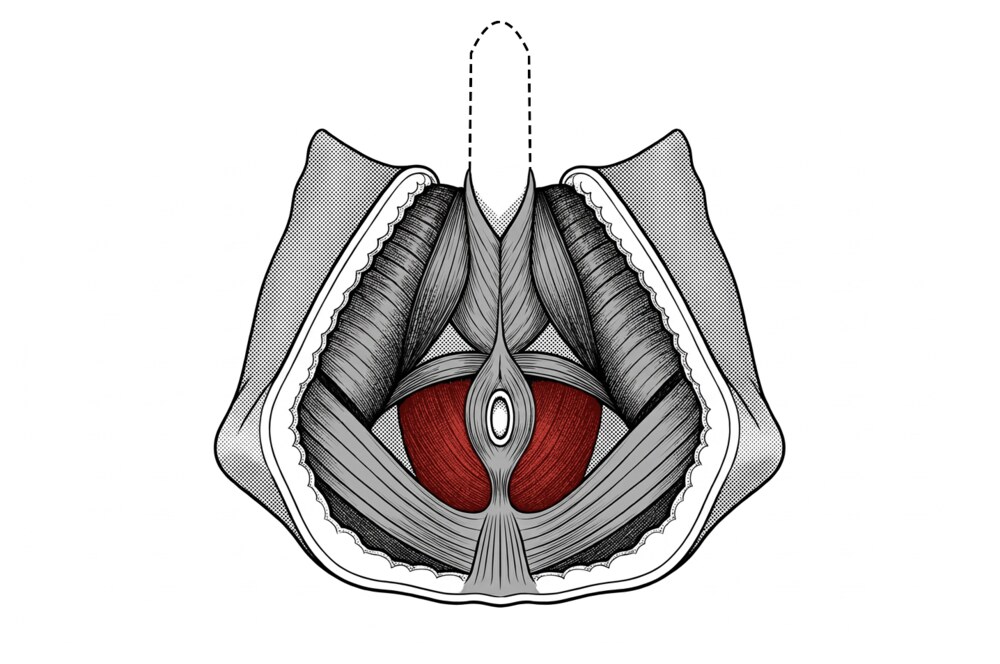
The PC muscle is the pubococcygeus, part of a sheet of muscle called the levator ani that forms the floor of your pelvis. It runs from the pubic bone at the front to the tailbone at the back, holds up the bladder and bowel, and helps close off urine flow. It is the muscle most men feel when told to “stop the flow” or “hold in gas”, which is why nearly all kegel advice for men is written around it.
For erections, though, it is the support act. The two muscles that firm and hold an erection, the ischiocavernosus and the bulbospongiosus, sit in the layer just below it, at the base of the penis. The PC muscle is the way most men first find the pelvic floor. Training only the PC muscle can miss the two muscles that matter most for firmness.
Where it is
Picture a hammock slung inside the bottom of your pelvis. The levator ani is that hammock, and the pubococcygeus is its front and middle part. The urethra and the rectum pass through it. Below it, closer to the skin, is a thinner outer layer that holds the bulbospongiosus and ischiocavernosus.
What it does
Holds things up. It keeps the bladder, prostate and bowel supported, and tightens when you cough, lift or jump so pressure doesn’t push urine out.
Closes off urine and gas. Squeezing it narrows the urethra and the back passage. That is the “stop the flow” feeling.
Backs up the outer muscles. The pelvic floor contracts as a unit. When you squeeze hard, the deep layer and the outer layer fire together, and the deep layer gives the outer muscles a firm base to press against. Reviews of pelvic-floor function in men treat the whole floor, not one muscle, as the thing that raises penile pressure to full rigidity.[1]
Why the PC muscle is the one you have heard of
Kegel exercises are named after Arnold Kegel, a gynaecologist who published them in 1948 as a treatment for women.[5] Most advice for men still starts from the muscle women were taught to find: the PC muscle. It is easy to explain and easy to feel. The muscles that do the most for erections have long names and sit in a spot men don’t think about, so the usual instruction stops at “find your PC muscle and squeeze.”
That works up to a point, because a strong squeeze brings in the whole floor. The problem is the cue. “Stop the flow” and “hold in gas” lean toward the back and middle of the pelvic floor. In a study of young men watched on ultrasound, cues aimed at the base of the penis (“shorten the penis”, “lift the scrotum”) got over 91% to contract the right muscle, while “draw in” got 25%.[2]
How to find it, then go further
- Once, while urinating, slow the stream. The squeeze you use is mostly the PC muscle. Don’t make this a habit; it is only for finding the muscle.
- Lying down, repeat that squeeze without urinating. Keep your stomach and buttocks soft.
- Now shift the squeeze forward: pull the base of the penis in, as if shortening it, and lift the scrotum. You should feel the base of the penis twitch. That brings in the bulbospongiosus and ischiocavernosus on top of the PC muscle.
- Hold a few seconds while breathing, then let go fully.
Use step 3 for daily training. The ED trials trained the whole floor this way, with long holds and quick flicks, twice a day, made harder week by week.[3]
Common questions
Is the PC muscle the same as the pelvic floor? It is one part of it. The pelvic floor includes the deep levator ani (with the PC muscle) and the outer layer with the muscles at the base of the penis.
Does a stronger PC muscle mean stronger erections? It helps as part of the whole floor. On its own, it is not the muscle that raises penile pressure; the ischiocavernosus is.[4] What training the whole floor does for erections is in Do Kegels Help With ED?
Does the PC muscle help bladder control? Yes. It is the main muscle for holding urine in under pressure, which is why it is the focus after prostate surgery and for leaks when you cough or lift.
Where Sahara fits
Sahara’s quiz asks what you want to fix, and the Full Strength Protocol uses cues that bring in the muscles at the base of the penis, not only the PC muscle. It gets harder on a set schedule over twelve weeks, takes 5 minutes a day and tracks every session. How the three muscles work together is in The Three Muscles Behind Every Erection.
References
- Meldrum DR, Burnett AL, Dorey G et al. J Sex Med 2014;11(5):1208–20. PubMed
- Ben Ami N, Feldman R, Dar G. Verbal instruction for pelvic floor muscle contraction among healthy young males. Int J Environ Res Public Health 2022;19(19):12031. PubMed
- Dorey G et al. Br J Gen Pract 2004;54(508):819–25. PubMed · Full text
- Clement P, Giuliano F. Anatomy and physiology of genital organs: men. Handb Clin Neurol 2015;130:19–37. PubMed
- Kegel AH. Progressive resistance exercise in the functional restoration of the perineal muscles. Am J Obstet Gynecol 1948;56(2):238–48. PubMed
Related articles
Educational content, not medical advice. See a clinician for pain, blood in urine, or sudden changes. Results vary; the cited trial reflects its study population. Sources for every figure are available on request. Erection problems can be an early sign of heart or blood-vessel trouble, so see a doctor as well.