The Three Muscles Behind Every Erection, and How They Work Together
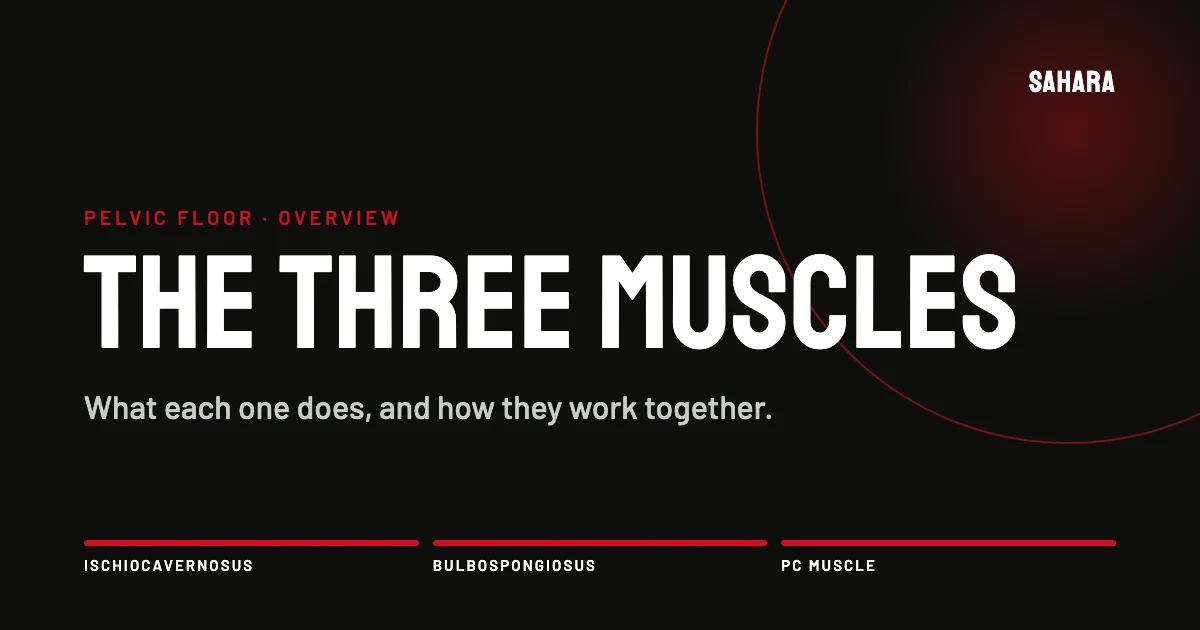
Three pelvic-floor muscles come up whenever erections and kegels are discussed. The ischiocavernosus squeezes the roots of the penis and pushes the pressure inside above your blood pressure, which makes it rigid. The bulbospongiosus (bulbocavernosus) wraps the base and presses on the main draining vein, so the blood stays in. The pubococcygeus, or PC muscle, is the deeper sling that holds everything up and gives the other two something to push against.
None of them starts an erection. Blood vessels do that. The muscles take a full erection and make it hard, and keep it hard during sex.
Two layers, three muscles
The pelvic floor has two layers that matter here.
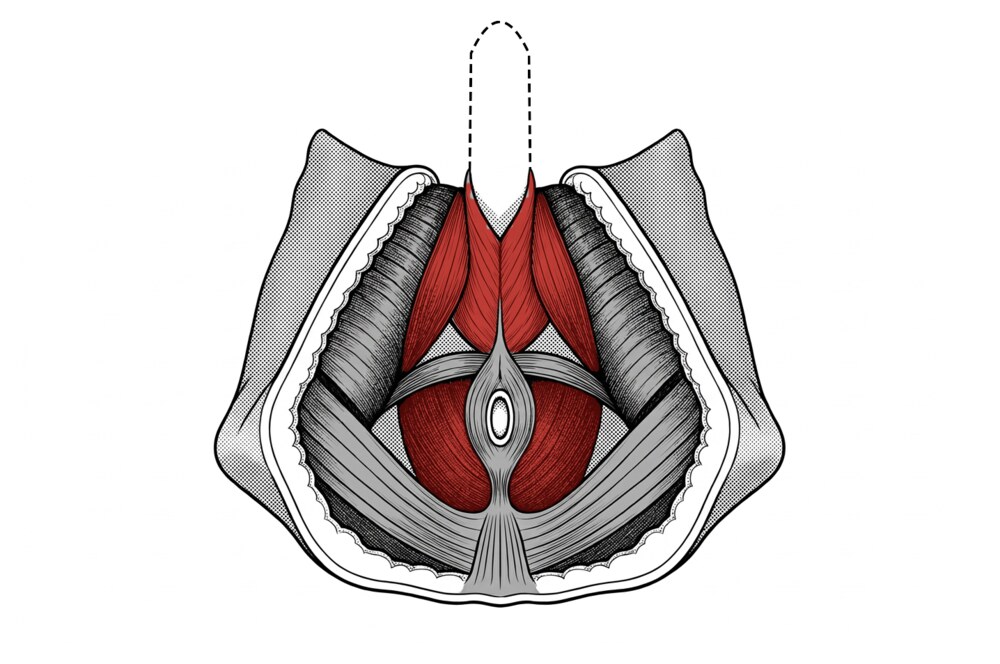
The deep layer is the levator ani, a hammock of muscle across the bottom of the pelvis. The PC muscle is its front and middle part. It supports the bladder and bowel and closes off urine flow.
The outer layer sits just below it, behind the scrotum. It holds the two muscles that work directly on the penis: the ischiocavernosus, one on each side over the roots of the shaft, and the bulbospongiosus in the middle over the bulb.
What happens, in order
1. Filling. With arousal, the arteries and spongy tissue of the penis relax and blood rushes in. Pressure rises to about your blood pressure. The muscles are quiet: needle recordings found them silent during an erection from visual arousal alone.[1]
2. Holding. As the penis swells, it presses its own draining veins shut against its tough outer casing. The bulbospongiosus adds to that by compressing the deep dorsal vein, which slows blood leaving.[2]
3. Rigidity. During thrusting and touch, the ischiocavernosus contracts in bursts. It squeezes blood that can’t escape, and the pressure spikes far above blood pressure. Voluntary squeezes in nine men raised it by 100 to 525 mmHg.[3] This is the step from full to hard.
4. Support. Whenever the outer muscles squeeze hard, the PC muscle and the rest of the deep layer fire with them and brace the base. Specialists describe the pelvic floor as a whole raising the pressure “above maximum inflow pressure to achieve full penile rigidity”.[4]
5. Finish. At orgasm the bulbospongiosus switches to rhythmic pulses that push semen out.[5] Afterwards, as the muscles relax and blood drains, the erection goes.
Which one fails, and what it feels like
| If this is weak | You may notice |
|---|---|
| Ischiocavernosus | Full but never fully hard; “about 80%” |
| Bulbospongiosus | Hard at first, then fades, especially when you change position or put on a condom; also drops of urine after you’ve zipped up |
| PC / deep layer | Leaks when you cough or lift, and a weaker squeeze overall |
In practice they weaken together, because they are trained (or not trained) together. Sitting a lot and getting older both weaken them. That is why the trials trained the whole floor, not one muscle.
What training them does
In the best randomised trial, men with erection problems who trained their pelvic floor for three months scored 7 points higher on the standard erection questionnaire than men given lifestyle advice only. After six months, 41 of 55 had improved and 22 were back to normal.[2] Results were best in men who get hard but can’t stay hard, which is the job of the outer two muscles. The full set of trials is in Do Kegels Help With ED?
If you rarely get hard at all, even in the morning, the filling stage is the more likely problem. The muscles can only squeeze what has already filled.
How to train all three at once
You can’t fire them one by one, and you don’t need to. One well-cued squeeze brings in all three. The cue decides which part leads. In a study of young men watched on ultrasound, “shorten the penis” and “lift the scrotum” got over 91% to contract the right muscle; “draw in” got 25%.[6]
- Relax your stomach, buttocks and thighs.
- Pull the base of the penis in toward your body and lift the scrotum. The base should twitch in.
- Hold for a few seconds while breathing normally, then let go completely.
- Mix long holds (for staying power) with quick hard flicks (for the bursts during sex).
- Add one strong squeeze after you urinate. It trains the bulbospongiosus and clears the last drop.
Dorey’s programme ran twice a day and got harder each week. The measured gain came at three months.[2]
Common questions
Which of the three is most important for erections? The ischiocavernosus for hardness, the bulbospongiosus for keeping it. The PC muscle supports both.
Why is the PC muscle the one everyone has heard of? Kegels were designed for women, and the PC muscle is the easiest one to feel. The outer muscles at the base of the penis do the direct work in men.
Do I need different exercises for each? No. The right cue and a mix of holds and flicks covers all three.
Where Sahara fits
Sahara’s Full Strength Protocol trains all three with cues aimed at the base of the penis, holds and flicks that get harder on a set schedule over twelve weeks, and the after-void squeeze. It takes 5 minutes a day, sends a notification at the times you pick, and tracks every session so you can see whether it is working.
References
- Gerstenberg TC, Levin RJ, Wagner G. Br J Urol 1990;65(4):395–402. PubMed
- Dorey G et al. Randomised controlled trial of pelvic floor muscle exercises and manometric biofeedback for erectile dysfunction. Br J Gen Pract 2004;54(508):819–25. PubMed · Full text
- Lavoisier P et al. Correlation between intracavernous pressure and contraction of the ischiocavernosus muscle in man. J Urol 1986;136(4):936–9. PubMed
- Meldrum DR, Burnett AL, Dorey G et al. J Sex Med 2014;11(5):1208–20. PubMed
- Clement P, Giuliano F. Anatomy and physiology of genital organs: men. Handb Clin Neurol 2015;130:19–37. PubMed
- Ben Ami N, Feldman R, Dar G. Verbal instruction for pelvic floor muscle contraction among healthy young males. Int J Environ Res Public Health 2022;19(19):12031. PubMed
Related articles
Educational content, not medical advice. See a clinician for pain, blood in urine, or sudden changes. Results vary; the cited trial reflects its study population. Sources for every figure are available on request. Erection problems can be an early sign of heart or blood-vessel trouble, so see a doctor as well.