Still a Few Drops After You’ve Zipped Up? 5 Things That Help Today
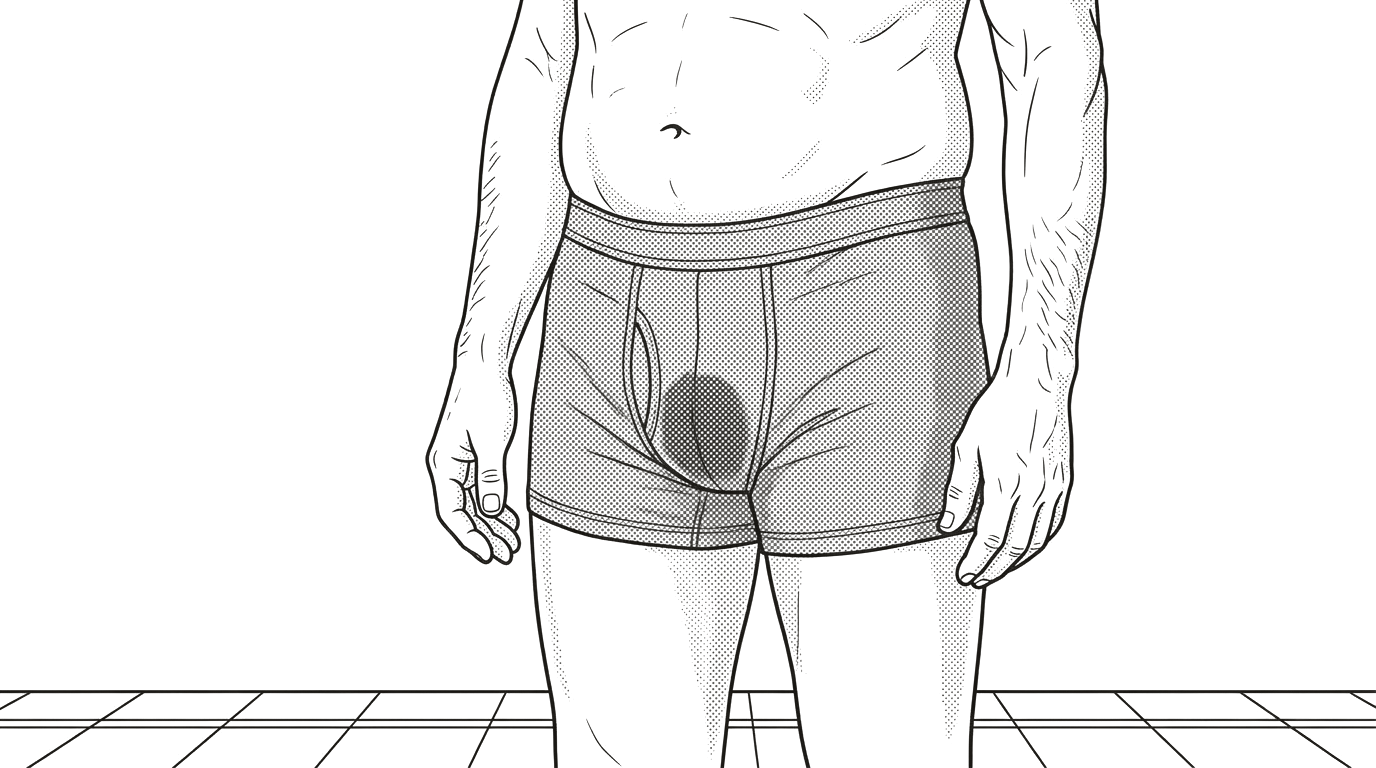
Post-micturition dribble is the involuntary loss of a few drops of urine immediately after urinating. It affects roughly one in four men by their fifties.[1] If you’re dealing with it, you likely just want to know how to stop the leaking so you don’t have to worry about clothing stains.
It is not something you caused. It comes from a muscle that tends to get weaker with age, and nobody teaches men that muscle is there.
There are several physical tricks you can use to minimize the issue right now. While they won’t fix the underlying cause, they provide immediate, practical relief.
Here are five proven techniques that alleviate after-dribble in the short term, followed by what the trials show works on the cause.
1. Sit down
A 2014 systematic review and meta-analysis pooled eleven studies comparing sitting and standing during urination.[2] The data showed that for men with an enlarged prostate, sitting down resulted in a more complete emptying of the bladder (leaving approximately 25 ml less urine behind).
If prostate enlargement is a factor for you, sitting can reduce the volume of urine left in the system, which directly reduces subsequent dripping. If your prostate is normal, sitting will likely not change the outcome, as the fluid is trapped lower in the urinary tract.
2. Wait longer
This is one of the easiest behavioral adjustments you can make. It relies entirely on gravity to drain the urethra. Allowing extra time simply ensures that the remaining fluid drips into the toilet rather than into your clothing.
This method works best when you allow your bladder to empty without straining. Actively forcing the end of the stream tends to tense muscles that trap more urine in the urethra.
3. Use manual pressure (Urethral milking)
Applying physical pressure is highly effective, provided it is done correctly. The clinical term for this is urethral milking. The correct technique involves placing two fingers behind your scrotum (on the perineum) and applying gentle upward pressure, then drawing your fingers forward toward the base of the penis.
This works because urine pools in the natural curve of the urethra located behind the scrotum. Proper manual pressure forces this pooled liquid forward and out. Applying pressure too far forward on your anatomy is ineffective because it bypasses the curve where the fluid is trapped.
4. Make a second trip
If you have the time, you can manage the issue by urinating, leaving the bathroom for a minute or two, and then returning to void a second time. Walking around displaces the pooled urine, making it easier to catch on a second trip.
While this prevents clothing stains entirely, it is a disruptive habit that requires constant logistical planning and extends bathroom visits significantly.
5. Relax your pelvis
Leaning forward slightly and consciously relaxing your abdominal wall and pelvic floor at the end of urination can aid clearance. Tensing your stomach or pelvic muscles prematurely pinches the urethra and traps urine. Conscious relaxation allows the final volume to exit smoothly, particularly when combined with waiting a few extra seconds.
Why these tricks are only short-term fixes
All five of these methods focus on clearing trapped fluid after the fact. None of them address the structural reason the fluid is trapped in the first place.
The natural clearance of the urethra is handled by the bulbocavernosus, a muscle located at the base of the pelvis that wraps around the urethra.[3] Its physiological function is to contract at the end of urination, effectively squeezing the remaining fluid out. When this muscle weakens with age, it fails to contract forcefully enough to empty the tube. Nobody is taught to train it, so most men never find out it is there.
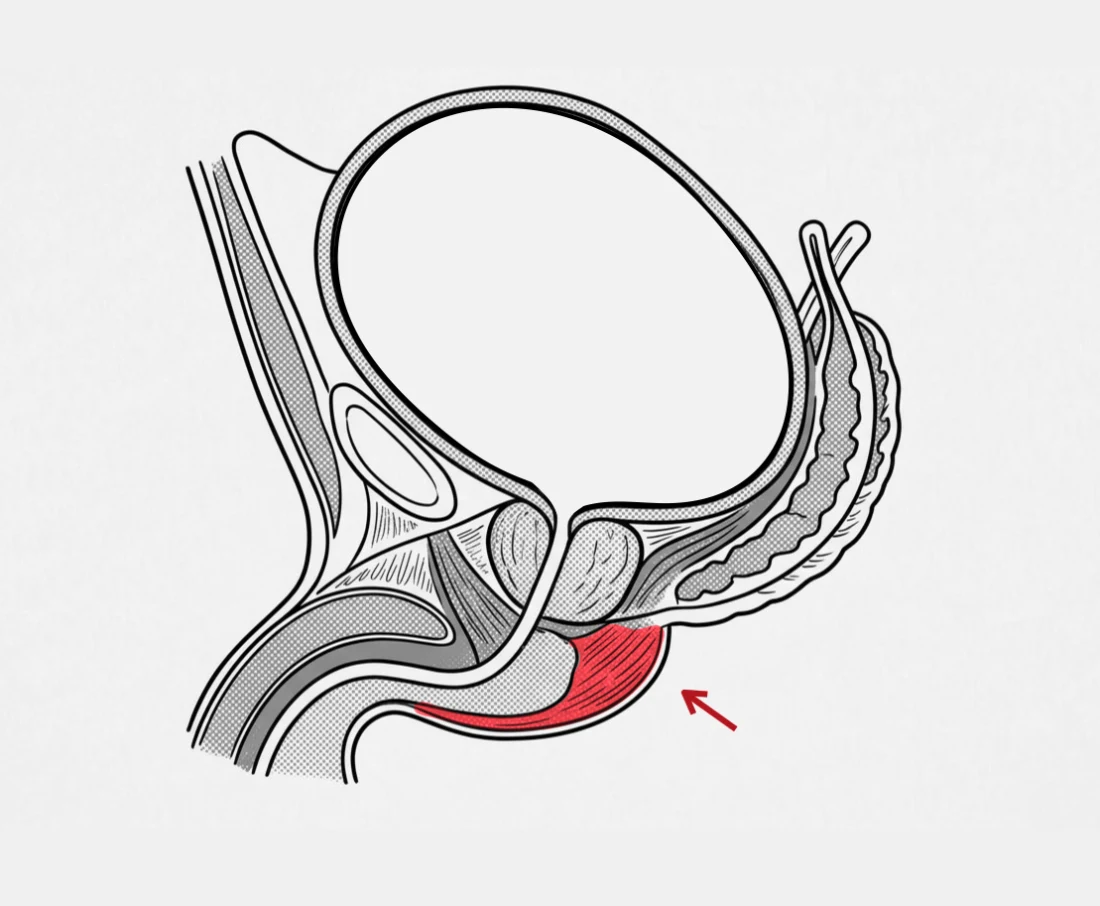
The techniques listed above do this muscle’s job for it. They are sensible, and they are all anyone offered you. They just cannot make the muscle stronger.
The long-term solution
Training the bulbocavernosus is what the trials show works on the cause.
A 1997 randomised trial directly compared manual pressure (urethral milking) to pelvic floor muscle training in 49 men.[4] The group performing the muscle training showed the largest reduction in leakage, ahead of the group relying on manual pressure. Furthermore, a randomised controlled trial demonstrated that after a structured pelvic floor training program, three months supervised and three at home, 75% of men with post-micturition dribble became completely symptom-free.[5]
Training the muscle takes several weeks of exercises that get harder on a schedule. That is too much to plan and track in your head, so the program should do it for you: pick the correct squeeze, raise the dose week by week, and give you a number to watch so you know by week five whether it is moving.
Sahara’s two-minute assessment tells you whether yours is the kind of dribble that training ends, and builds the 12-week protocol from your answers: how long you have had it, how much, and what you have already tried. After that, the app plans every session, reminds you when, counts every hold and raises the dose by itself. You give it 5 minutes a day.
References
- Post-micturition dribble in a general population of men aged 20–59: 17.1% overall, 26.9% in their fifties. Hinyokika Kiyo 1997;43(6):407–10. PubMed 9250489
- de Jong Y, Pinckaers JHFM, ten Brinck RM, Lycklama à Nijeholt AAB, Dekkers OM. Urinating standing versus sitting: position is of influence in men with prostate enlargement. A systematic review and meta-analysis. PLoS One 2014;9(7):e101320. PubMed 25051345 · Full text
- Yang DY, Lee WK. A current perspective on post-micturition dribble in males. Investigative and Clinical Urology 2019;60(3):142–147. Full text
- Paterson J, Pinnock CB, Marshall VR. Pelvic floor exercises as a treatment for post-micturition dribble. British Journal of Urology 1997;79(6):892–897. PubMed 9202555
- Dorey G, Speakman M, Feneley R, Swinkels A, Dunn C, Ewings P. Randomised controlled trial of pelvic-floor exercises for post-micturition dribble. Urologic Nursing 2004;24(6):490–497. PubMed 15658735
- Sahara assessment answers, about 300 men, September 2026. Self-selected, not a prevalence figure.
Every paper, with what it shows and what the site simplifies, is on the science page.
This article is general information, not medical advice. Pain or burning, blood in the urine, fever, or a sudden change in the last few weeks need a clinician before any training.
Related articles
Educational content, not medical advice. See a clinician for pain, blood in urine, or sudden changes. Results vary; the cited trial reflects its study population. Sources for every figure are available on request.